Guide
How to Reset a Sub-Zero Freezer, and When the Reset Is Not Enough
To reset a Sub-Zero freezer, switch off its breaker for 30 seconds and turn it back on, cleaning the condenser first if Service is flashing. Here is what each panel warning means and when a dark display points to a failed part.
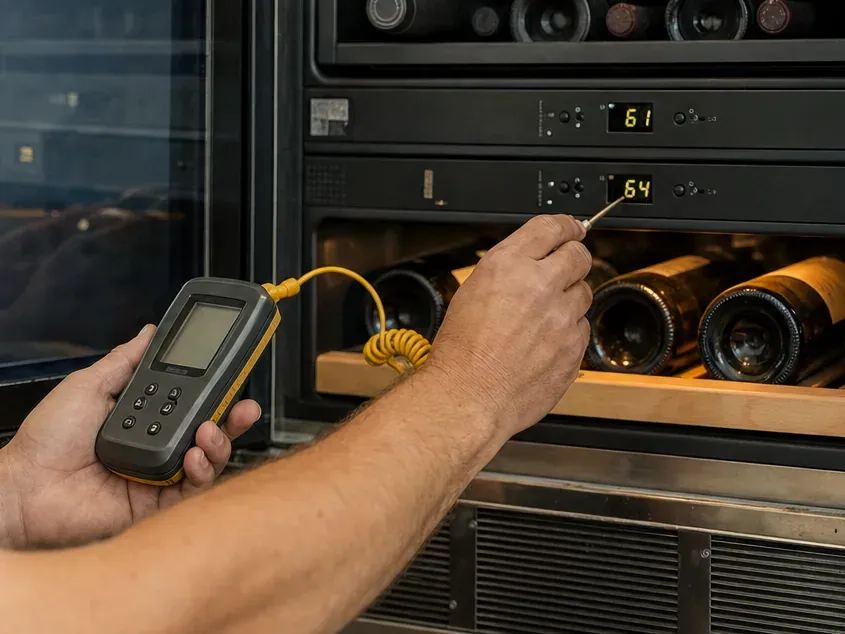
To reset a Sub-Zero freezer, turn off the breaker that feeds it at your electrical panel, wait 30 seconds, and switch it back on. If the word Service was flashing and the temperatures were close to where you set them, clean the condenser before you do it, since Sub-Zero ties that message to a compressor that has been running too long. The power cycle restarts the control and clears the warning, but it repairs nothing: a bad fan, sensor or seal will bring the message straight back. Below is what to read on the panel first, which warnings a reset genuinely fixes, and when a blank display means a part has failed.
The reset, one step at a time
- Write down what the display shows. Note any code, any flashing word and both zone temperatures. Cutting the power erases that evidence.
- Check the doors. Make sure a tray, a bag of frozen berries or a bin pulled slightly forward is not holding a door open by a fraction of an inch. Sub-Zero lists a door left ajar among the causes of an overworked freezer compressor.
- Clean the condenser if Service or Vacuum Condenser was flashing. With the power off, remove the grille (above the doors on most tall built-ins, down at the toe kick on undercounter units) and vacuum the fins gently with a soft brush attachment, moving along the fins rather than across them.
- Cycle the breaker. Find the unit’s dedicated breaker, switch it off for 30 seconds and switch it back on.
- Watch the temperatures. The display should relight and the compressor should start. Over the next few hours the readings should move steadily toward the set points instead of stalling.
Read the panel before you clear it
Here is what the common Sub-Zero messages mean:
- Service flashing between the zone temperatures. The compressor has been running excessively. With temperatures near normal, Sub-Zero’s answer is to clean the condenser and turn the home breaker off for 30 seconds, which is the reset above.
- EC40 with Service flashing. The freezer compressor has been working overtime, and Sub-Zero traces that to one of a handful of things: a freezer door that never fully shut, a weak fan, a failing temperature sensor or trouble in the sealed refrigerant loop. The 10° line decides your next move. A freezer reading less than 10° over its setting usually just needs a clean condenser, while one running warmer than that by more than 10°, with the door known to be closed, calls for a technician. Clearing the code again and again as the number keeps creeping up only buys time the food does not have.
- Vacuum Condenser flashing. The control has noticed temperatures drifting up or the system straining harder than it should. Dust on the condenser is the usual trigger, though a poor door seal or an internal fault can cause it too. Once the coil is clean, switching the unit off and on again clears the warning.
- EE alongside a blinking Service or wrench. One of the thermistors has failed. Which side of the display the EE appears on tells you where: left for the freezer, right for the refrigerator. Sub-Zero gives owners no troubleshooting for this one, so a reset achieves nothing.
- The wrench icon on older Classic BI panels. Blinking along with a chime, it signals that a major error code was stored; lit steadily while the chime sounds, it marks a minor fault that is not endangering your food temperatures.
Quieting an alarm is not the same as fixing it
A Classic BI that keeps chiming can be hushed by holding the ALARM and POWER keys at once, then releasing them before 5 seconds are up. That hides the fault indicator for 24 hours. The malfunction remains, and the warning will return.
One alert on those panels is genuinely yours to clear. When a lone ice cube symbol blinks and the alarm stays silent, the control has switched the ice maker off because its fill valve was open for too long, a safeguard against water spilling into the cabinet. Look at the water supply first: the shutoff should be fully open and the tubing free of kinks. Then press and keep holding Alarm; once CFC, short for Clear Fault Codes, shows up, the fault is cleared. If that symbol keeps returning, the valve or supply line needs work, which typically costs $290–$760.
A lit display over a warm freezer
A glowing panel over a warm cabinet often means a mode, not a breakdown. The letters Sh r on an older Classic BI tell you it is in Showroom Mode: lights on, compressor idle. Getting out takes three keys. Switch the unit off with Power, press and hold one Warmer and Colder pair, tap Power, and let go of everything together. Newer Classic and Designer models give a different hint, a steady 38° and 0° on the panel while the cabinet warms, which may also mean Showroom Mode; in that case Sub-Zero points owners to its customer care team. On the PRO 36 and PRO 48, Showroom mode survives a power failure, so an outage will not clear it; it is switched off through the password-protected Service screen inside the Settings menu.
Sabbath Mode behaves the same way. It turns off the ice maker and the door alarm, holds them off, and comes back after a power cut. If ice production stopped after an outage, look for Sabbath Mode before suspecting the ice maker.
Power trouble that looks like a dead freezer
Confirm the power reaching the unit before blaming the freezer. Sub-Zero’s installation guide for Classic CL refrigerators calls for a 115 VAC, 60 Hz supply on a 15 amp dedicated circuit with a 3-prong grounding-type receptacle, and it recommends against a GFCI because one may interrupt operation. If your unit shares a circuit with other kitchen appliances or sits behind a GFCI that keeps tripping, the freezer may be healthy and the wiring is the real issue, which is work for an electrician.
Xcel Energy has switched off power to parts of Boulder ahead of high-wind days with elevated fire danger, sometimes for many hours. Our page on what to do before Xcel cuts the power covers the preparation. While the power is out, keep the doors shut: Sub-Zero says an empty unit usually needs 3 hours to climb above 45°F (7°C) in the refrigerator and 20°F (-6°C) in the freezer. Afterwards, thawed food still holding ice crystals or at 40°F (4°C) or below can go back in the freezer, though quality may suffer. Never taste anything to judge whether it is safe.
When a blank display means a failed part
If the breaker is on, has not tripped again, and the display stays dark even after a 30-second power cycle, the fault is inside the unit. The likely suspects are the electronic control board, its power supply or a loose wiring connection, and none of them respond to another reset. The same goes for a display that lights while the freezer refuses to get cold after the condenser is clean and the modes above are ruled out; that points toward a fan, a defrost part or the sealed system.
A flat $89 visit covers the whole diagnosis, and that $89 comes off the repair if you approve it. As a guide, a control board typically costs $420–$960, an evaporator or condenser fan motor $340–$720, a defrost heater, thermostat or sensor $270–$650, and compressor or sealed-system work $1,440–$3,190, with the firm quote given once the cause is confirmed. From Gunbarrel to Far South Boulder and Shanahan Ridge, you can arrange a visit through our refrigerator, freezer and ice maker repair page or by calling (720) 580-4040.
Questions
Why would the fridge side of a Sub-Zero warm up while the freezer stays cold?
Many Sub-Zero built-ins cool the two sections separately, so one side can fail while the other carries on. A stalled fan, an iced-over evaporator or a dirty condenser are typical culprits. Rule out Showroom Mode, clean the condenser and cycle the breaker for 30 seconds; if the fresh-food side is still warm afterwards, it needs a proper diagnosis.
How long will a Sub-Zero freezer stay cold during a power outage?
Roughly 3 hours for an empty unit, by Sub-Zero's own figure, before the freezer passes 20°F (-6°C), and a well-stocked one lasts longer. Open the doors as little as you can until the power is back, then sort the food: items with ice crystals left, or at 40°F (4°C) or colder, are fine to refreeze.
Will a power cut change my freezer's settings?
It can leave certain modes switched on, because some are designed to survive an outage. Sabbath Mode, which shuts off the ice maker and the door alarm, resumes when the power returns, and a PRO 36 or PRO 48 left in Showroom mode does the same. Check for both before assuming something broke.
What is the right way to defrost a Sub-Zero freezer by hand?
Turn it off at the control panel or the breaker, move the food to coolers, prop the door open with towels underneath, and let the ice melt by itself instead of chipping at it or using heat. A frost-free freezer that keeps building heavy frost has an underlying cause, most often a door that is not sealing or a failed defrost part.
What does it cost if the reset does not fix my freezer?
The visit is a flat $89 that covers the complete diagnosis and is credited against the repair if you go ahead. What follows depends on the cause: an electronic control board typically runs $420–$960 and a fan motor $340–$720, and you get a firm quote once the fault is found.
A zone drifting, or a dark panel?
Call Flatirons Wine Cooler Repair at (720) 580-4040. The phone is answered 24/7; visits run 8:00 am – 8:00 pm, seven days.